12 July 2010

Irish Pubs: The Danger

One of our "musts" in Ireland was live music. Everything we read said that you can't go to Ireland without popping into a couple pubs in the evening to hear the live music. What they don't tell you is to beware the friendly Irish men who've been drinking and are on the lookout for girls to flirt with.

We met one such young man who'd obviously thrown back a few pints by the time he sat down at our table. The conversation was most stimulating:

(read italics in an unenthusiastic and off-puting voice)

Sir Drinks-a-Lot: Hello, girls.
Us: Hi.
Sir Drinks-a-Lot: Where're you from?
Us: The States.
Sir Drinks-a-Lot: So do you have boyfriends?
Stacy (for us both): Yes. (Jen chose not to clarify.)
Sir Drinks-a-Lot: Why aren't they with two such beautiful girls?
Us: We're very trustworthy girls.
Sir Drinks-a-Lot: Where are you staying?
Stacy: Somewhere.
Jen: Down the road. (Irish translation: somewhere within a two-mile radius of here.)
Sir Drinks-a-Lot: Ah. You're beautiful girls.
Us. Thanks.

Sir Drinks-a-Lot: Well. Have a good holiday.
Us: Bye.

And that, dear friends, is how to get rid of a drunken (and friendly) Irishman.

In spite of this, we had a great time. The pub felt very safe -- lots of locals and tourists watching the exchange and laughing. And the music was awesome.

Dublin sights

Our second day in Dublin was a bit of a blitz trip.


We started at Trinity College to see the Book of Kells. This really was an incredible moment to see the book that was writen over a thousand years ago with the 4 gospels written in Latin and beautifully illustrated. They think it was produced in the early 9th century by the monks of the island of Iona at Iona or Kells. One of the things I am constantly touched by is how God preserves his people (there is always a remnant) and his word. We can believe in the accuracy of scripture as again and again we find exact copies. In this case, because Ireland was a little wild and just a bit farther than England, the Roman Empire didn't stretch that far. Because of this, when the Roman Empire pulled back and ultimately fell, plunging Europe in the Dark Ages, Ireland was largely untouched and able to continue it's work and the Book of Kells was preserved coming to Dublin around 1653 for security during the Cromwellian period. Very cool!


From there we went to the National Museum of Ireland which mostly contains items of archeological significance. It's hard to sometimes see one more rock or piece of pottery, but Jen hung in there. I lost her, however, at the special exhibition about kingship and sacrifice. (She finally just got grossed out and left.) I, however, found it absolutely fascinating! I had just read in a Time magazine on the most important historical and scientific discoveries in the last hundred years (Yes, I am that dorky!) about the bog people. These were people that had been preserved because they were thrown into the bogs. They were able to tell how they died, what their diet was for the last 4 months (because of their fingernails), and even what they had eaten the day they died. Their clothes were preserved and you could see the style and coarse weave of the preserved fabric. One man's hair was even analyzed to find a hairstyling gel that was from France or Spain. All in all, it is an amazing glimpse into that Iron Age culture.

After that we went to the National Gallery of Ireland. We both enjoyed some of the Rembrandt paintings "Escape to Egypt" and the Vermeer "Lady Writing a Letter" and Velazquez's "Kitchen Maid with the Supper at Emmaus."

From there we went to the National Library of Ireland. We visited a W.B.Yeats exhibit and were sad to find that although he had some beautiful poetry, he was also a womanizing occultist. It kind of ruined him for us.

Of course no stop in Dublin is without going to the Temple Bar area where we visited a cool music shop. Then back to our B&B for the night.

08 July 2010

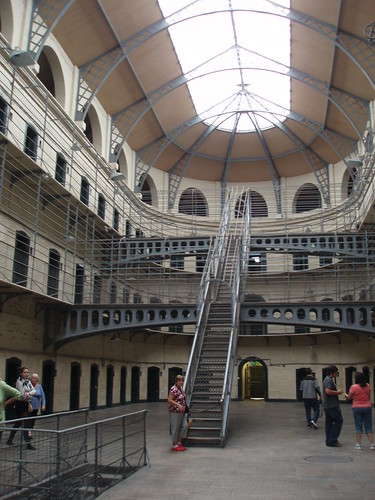
Kilmainham Gaol

Sobering. I believe they say the "gaol" was in use from the late 1700's to about 1924. It was a prison for reform. The philosophy of the prison's architect was "silence, supervision, and separation." It was for men, women, and children (the youngest recorded at 5 years old). Many of the charges were for small things like the stealing of bread or potatoes, begging, or riding a train without a ticket. These offenses could result in imprisonment periods that were days or months long.

When a convict entered Kilmainham, he(or she) would be given a "welcome package" of a thin uniform and a 4-inch candle (which would be his only source of heat for the next 2 weeks). Because the building was made of limestone, the jail was extremely cold and damp. Diseases like tuberculosis and asthma abounded. Prisoners were to be separated in cells meant for one but with overcrowding often 5 prisoners would stay in one cell. They had one bucket for their latrine which they had to clean out themselves each day. Later that day, they had to use that same bucket for their food. This led to typhoid and dysentery. It wasn't until the Victorian era that heat was piped in and food was served in more health-conscious ways. Political prisoners were treated much better.

The jail is most infamous for housing and executing the leaders of the Easter Uprising in 1916. Fourteen of the sixteen leaders of the uprising were held at the prison and later executed. In his poem "Easter 1916", W.B. Yeats writes:
All changed, changed utterly:
A terrible beauty is born.
The decision to execute these leaders was seen as rash and unnecessary. Their deaths led to a unified struggle for self-rule -- rallying the country to finally declare independence from Britain in the 1920s.

The jail still stands as a reminder of the turmoil throughout Irish history and the spirit of the Irish desire for  freedom.

Wales to Ireland: A Survey of Public Transportation

J: "Hey, Stace?"

S: "Yeah, Jen?"

J: "Want to see how many different forms of transportation we can use in one day?"

S: "Uhhh... Not really."

J: "Ah, come on. It'll be fun."

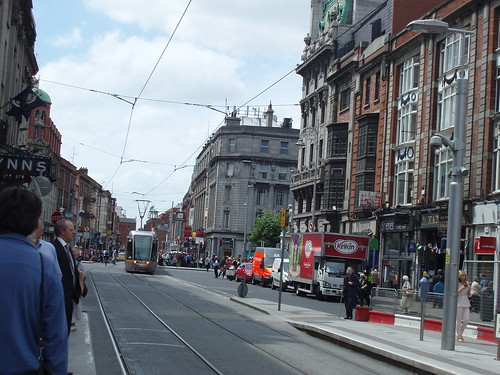
Yesterday was a little exhausting. We woke up early to inhale a fabulous English breakfast prepared by our hostess before hurrying off to catch an early train to Holyhead. Once arriving in Holyhead, we walked straight from the train to the ferry terminal. The crossing was uneventful, but the steady rocking made both of us sleepy. After dropping our bags at our B&B, we headed up to Dublin via light-rail AND tram. We ended up on a long, boring walk (slog, would be more accurate) along a motorway because "it didn't look that far on the map". (Thank goodness Stacy is a patient and gracious travel partner. That was a big oops on my part.) After touring the Gaol, we caught a bus back to the city center and wandered around there for awhile before catching the light-rail back to Dun Laoghaire, grabbing a bite to eat and talking while watching the Spain-Germany game at a local pub. Phew!


Did you catch all that?

walk--train--ferry--walk--light rail--walk--tram--walk--walk--WALK--bus--walk--walk--light rail--walk

It was a looooong day.

North Wales

After leaving the Newcombs we took the train up north to Conwy where we stayed for two nights.

This is Conwy Castle -- one of a ring of castles built by Edward I to control the rowdy Welsh leaders.

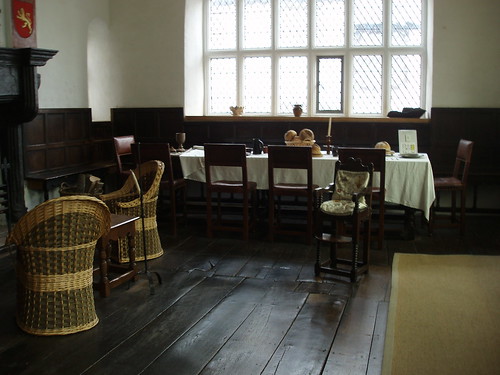
We also toured through Plas Mawr which is a house that has been restored to its Elizabethan glory. It had real artifacts from that time that you were allowed to touch. I thought it was fascinating that they put horse hair in the plaster mix to strengthen it before putting it on the walls and that the thresholds really were designed to keep in the rushes that were scattered on the floors of the home.


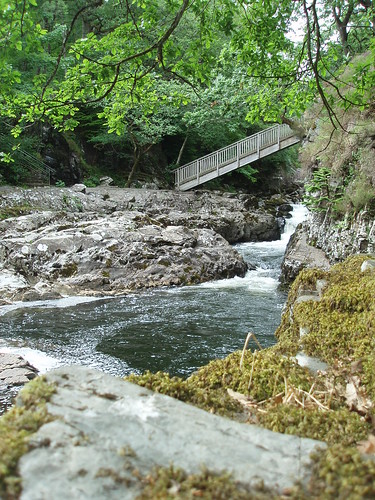
After the castle and Plas Mawr, we took a bus up to Betws-Y-Coed, which is near Mt. Snowdon and inside the Snowdonia National Park. There we took a forest walk alongside the river. We were hoping to find the much-lauded Swallow Falls, but to no avail! After an hour and a half of hiking (and no sign of the Falls) we turned back towards the town and had some ice cream instead. It was a perfect substitute, don't you think?


The next morning we said goodbye to Wales and headed to Ireland!

06 July 2010

Waving Hands, Flags, Clean Socks, and Clear Pee


I don't know if there is anything more wonderful when you are traveling than when you can stop and enjoy the comforts of being with friends in their home. We arrived at the Llantwit Major train stop after 4 train changes, a bus ride, and a taxi all that day. So it was one of the most beautiful sites in the world to see a light green car drive up to the station with a hand waving out of the driver's side window. There was Dellene, Anna, and Jessie Newcomb to meet us. We were all smiles and hugs!

Next we were taken through their quaint little town to a beautiful house with a recently "dodgy" garage door. Enter Josiah, who is getting quite tall and is nicknamed "flippy" for his hair. Unfortunately we missed out on Von, who had just left for a conference in Singapore. However, this only allowed for even more girl talks with Dellene, which were precious indeed.

One of the things we were looking forward to the most on this trip was the opportunity to see where our dear friends lived and walk a little bit in their shoes. It is always the hope that we can encourage them as part of the church that loves and cares deeply for them, to have them know that they are not forgotten, to see and know how better to pray for them in this new stage in their ministry. We certainly hope that they felt that from us!

What was not expected was the hospitality and care showered on us from each of them! Not only were we fed in grand style, but we also were able to wash and dry (in a dryer!) all of our clothes, and rehydrate.

Now, you may not think much of that, but as a Coloradan we have found that we seem to have an obsession with water. Having a sip of water seems to cure any sickness, and being without brings feelings of desparate panic close to the surface. One thing Jen and I were not expecting was the lack of places to get water and go to the bathroom when we are out and about. So, we drank water nonstop while we were there with our specially tagged glasses (best idea ever!) so we could reuse them all day. Brilliant!
On Sunday, we went to their church and enjoyed worshipping with an enthusiastic congregation. One of the things I loved during their singing is that there were people who brought flags to wave as part of their worship experience.

That evening, we also enjoyed spending time with their other American teammates for a 4th of July celebration, or as they say it here in the UK, "Revolution Day." Josiah says that in history here they talk about allowing America to be independent. He is very interested to learn American history this next year and see what is taught. We didn't have fireworks, but we did enjoy some great American food and patriotic music.

To finish off our time, Monday morning after the kids left for their walk to school in their uniforms, Dellene took us to the beach. We had a breathtaking view of the coast and walked a ways to have yet another wonderful discussion. Dellene has a passion for prayer and we discussed how often we give lip service to prayer's power and importance, but then will ask, "But what are you doing? What are your results?" How challenging to be reminded that prayer stands alone in its power and necessity. A missionary (isn't that all of us as Christians?) needs to be in prayer daily. We must be communion with God for this world, his people, and yes, for something he wants us to specifically do. There is so much more I could write about this and so much more that we talked about, but I am still processing it myself.


So, it is with heartfelt gratitude that Jen and I left the peaceful and refreshing time at the Newcombs with our hearts fuller, our socks cleaner, and our pee clearer!

04 July 2010

abbey in ruins

I visited Tintern Abbey years ago when I was in England with a study abroad program and I remember being enchanted with the ruins. It was one of those places I hoped to see again someday. Fortunately for me, Stacy hadn't been to Wales before, so it was on our must-see list.

The history, a la Rick Steves:
Founded in 1131 on a site chosen by Norman monks for its tranquility, [Tintern Abbey] functioned as an austere Cistercian abbey until its dissolution in 1536 ... Most of the external walls of the 250-foot-long, 150-foot-wide church still stand...
We spent over an hour and a half wandering through the ruins. These old churches are always impressive, but the abbey's ruins impress in a different way. The roof is long gone, but the walls continue to stretch up to the sky. The stone floor has been replaced by grass and flowers and a few brave plants have taken root on the walls themselves. I can't help but wonder how it will have changed in a hundred years. How long will it stay standing?

Get the flash player here: http://www.adobe.com/flashplayer


Nor wilt thou then forget,
That after many wanderings, many years
Of absence, these steep woods and lofty cliffs,
And this green pastoral landscape, were to me
More dear, both for themselves and for thy sake!
~ the final lines of William Wordsworth's "Tintern Abbey"